A car in Tenerife is not compulsory, but it changes the trip: without one you depend on transfers and the tourist areas; with one you reach Mount Teide, the green north and the fishing villages whenever you like. Hiring can be affordable, but the price varies a lot by season, car category, length and insurance cover. Before you book there are a couple of things worth knowing, especially about insurance. Here is the practical guide.
Do you really need a car in Tenerife?
| If you want... | Car? |
| Resort, beach and restaurants | Not needed |
| Organised excursions | Not needed |
| Teide on your own | Very useful |
| Anaga and the north | Recommended |
| Visiting several beaches | Recommended |
| A touring holiday | Almost essential |
It depends on how you travel. If you stay in the southern resorts (Costa Adeje, Los Cristianos, Playa de las Américas) and move between beach, restaurants and excursions with transfers included, you can do without one. A car becomes useful — almost necessary — if you want freedom: to go up Teide at your own pace, explore Anaga and the north, reach the fishing ports or change beach every day.
A middle ground is to hire a car only for two or three "discovery" days and use transfers or public transport for the rest. If you plan to stay in your area, also read the guide on where to stay in Tenerife without a car.
Where to pick it up: south or north airport
Tenerife has two airports, so book the pick-up at the one you land at:
- Tenerife South (TFS): handy if you stay in Costa Adeje, Playa de las Américas, Los Cristianos or Golf del Sur. It is the airport for most tourist flights.
- Tenerife North (TFN): convenient for La Laguna, Santa Cruz, Puerto de la Cruz and the north of the island.
You can also pick up in town or at your hotel, but the airport usually has more choice and better prices. Bear in mind the two airports are about an hour apart.
Which company and how to book
In Tenerife both the big international brands and long-standing local companies such as Cicar and Autoreisen work well, the latter valued for clear terms (often no deposit and a second driver included). Always compare what the rate includes, not just the headline price.
Book in advance: ideally four to six weeks ahead, when there is more choice and lower prices. Many flexible rates allow free cancellation up to a deadline: always check the conditions before booking.
Insurance: the line that makes the difference
This is where the surprises hide. Third-party liability is compulsory and always included, but the real difference is the excess (the amount you pay in case of damage).
- The cheapest comparator rates often have a high excess and block a deposit on your credit card.
- Zero-excess cover ("todo riesgo sin franquicia") taken from the provider can greatly reduce the financial risk in case of damage, but always check the excess, deposit and exclusions of the rate.
Weigh the total cost with full cover, not the base rate alone: that is the comparison that really counts.
Driving in Tenerife: rules and roads
You drive on the right and Spanish rules apply. Useful points:
- Toll-free motorways: the TF-1 links the south (Santa Cruz–Costa Adeje), the TF-5 the north. There are no tolls on the island.
- Limits: 120 km/h on motorways, 90 on main roads, 50 (or less) in town.
- Roundabouts: give way to those already on it and indicate when exiting.
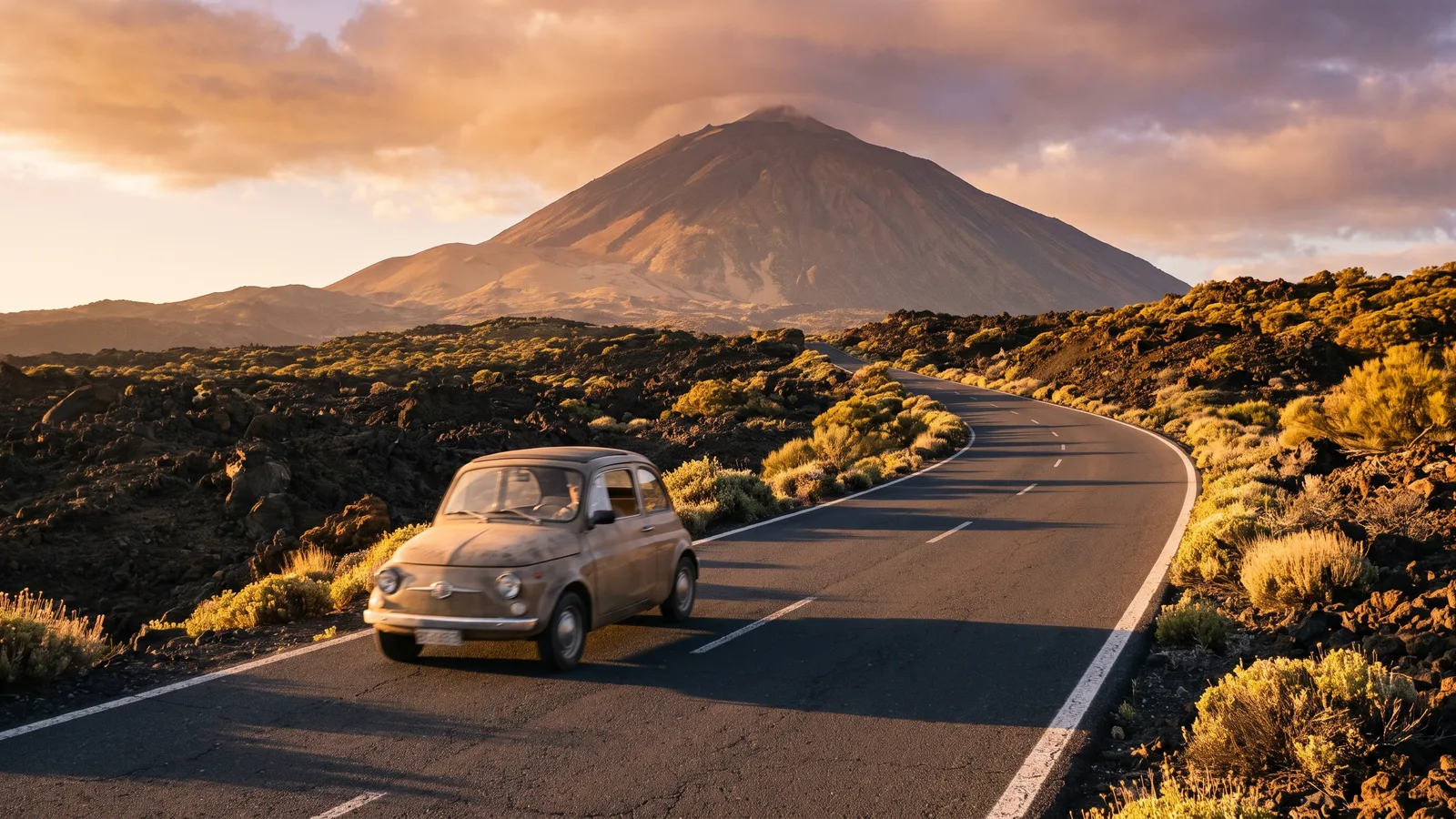
- Mountain roads: towards Teide, Masca and Anaga they are narrow and winding; use low gears uphill and downhill and take your time.
- Licence: an EU licence is fine. Outside the EU it is valid if written in Spanish or accompanied by an official translation; the international permit is not compulsory, but the DGT recommends getting one.
- Seatbelts and children: seatbelts for everyone; for children the Spanish rules on restraint systems apply (check height, age and the type of seat required before your trip).
- Footwear: avoid driving in flip-flops or shoes that could slip, get stuck or limit control of the pedals.
To plan your days by the weather between south and north, the guide on when to visit Tenerife is useful.
Fuel, parking and costs
Fuel in the Canary Islands is generally cheaper than in the rest of Europe, thanks to lower taxation: no small advantage if you drive a lot. For parking, in towns and tourist centres watch out for the zona azul (blue lines, paid at a meter); white lines are usually free and many resorts have their own car park.
The price of car hire varies a lot by season, car category, length and insurance cover: the final bill depends above all on the cover you choose and on extras (second driver, child seat, out-of-hours pick-up).
Scooter: when it makes sense
To get around town or along the coast, a scooter is a cheap option that is easy to park, available from many providers. You need the right licence (A or AM depending on engine size) and a helmet is compulsory. Less suitable, though, for the long climbs to Teide or the mountain roads.
How to save on your rental
- Book weeks ahead and make the most of free cancellation.
- Take the zero-excess cover from the provider instead of the base "bait" rate.
- Return the car with a full tank if the formula is "full-to-full", to avoid fuel surcharges.
- Check and photograph the car at pick-up and drop-off.
To see how much a car weighs on the cost of your holiday, start from the guide on the budget for a week in Tenerife; with the car ready, the next step is the best excursions on the island.
As with the rest of your trip, TPCard brings together the island’s verified partners in one place on your phone — car and scooter hire included — handy for seeing the benefits available before you book.